
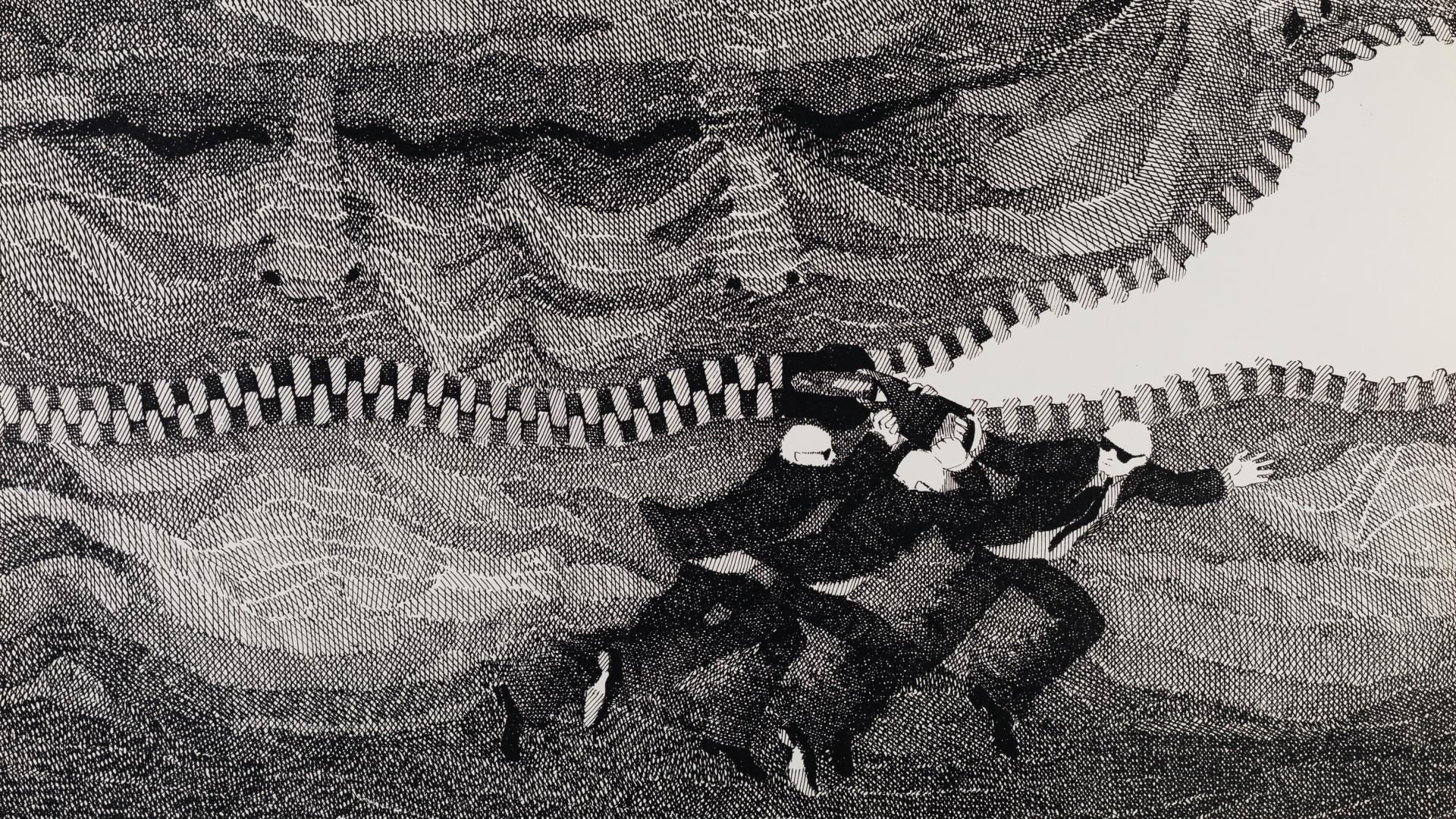
Valentina Cruz (Concepción, 1938 – Pirque, 2025) was an exceptional sculptor, illustrator, and teacher, recognized as a pioneering female artist whose practice advanced experimental approaches to both sculpture and drawing, beyond their conventional boundaries.
Her life and artistic trajectory were profoundly shaped by the geopolitical upheavals that defined the twentieth century. As the daughter of a diplomat, her childhood unfolded between Chile, Rome, and Moscow, exposing her from an early age to diverse political and cultural contexts. She witnessed firsthand the devastations of the Second World War and the tensions of the Cold War, experiences that would later inform the critical dimension of her artistic practice and her acute social sensibility. In the 1950s, she studied with an important artist and former director of MNBA, Nemesio Antúnez, and was part of the first class to enroll at Universidad Católica [Catholic University] Art School.
After experiencing the years of Allende´s Unidad Popular [Popular Unity] government and the military coup in Chile, she settled in Barcelona, where she lived for two decades before returning to her home country. Upon her return, she devoted her later years to teaching and, consistently, to processes of experimentation. If her early works were monstrous volumes, which led her to win the Paris Young Artists Biennial in 1965, she later turned to collages, detachable drawings, and installations on paper, mica, and acrylic. She expanded drawing as both a territory and a testimony, elevating the line to a kind of seismograph of life. With boldness and humour, she challenges human conflicts and transgresses the hierarchies between disciplines.
The exhibition Valentina Cruz. On Love, Humour, and Death brings together, for the first time on an extensive scale, a selection of more than one hundred and thirty pieces produced over six decades of artistic practice. This has been made possible largely thanks to the artist’s lifetime and posthumous donations to the museum, a sustained commitment that today allows her work to form part of the museum’s principal public collection. Far from being organised as a traditional retrospective, the exhibition proposes a transversal reading of her oeuvre, emphasising the persistence of certain questions: the experience of the body, the violence of power, and humour as a form of resistance and life.